
Fitness protein snacks company
BellRing Brands (NASDAQ: BRBR) shares are trading just above its pandemic levels but underperforming the benchmark
S&P 500 index (NYSEARCA: SPY). The Company products fall under the global convenient nutrition segment with ready-made protein drinks, shakes and bars found “conveniently” at grocers, gas stations and convenience stores. The COVID-19
pandemic had a severe impact on convenience store outlets with the stay-at-home mandates, but as the restart accelerates as
more commuters hit the road , BellRing Brands should benefit from increasing traffic. A second tailwind from
fitness at home trends should also sparked growth as more consumer opt to exercise from home rather than risk their health in
gyms. BellRing Brands was an October 2019 IPO as a spin-off of the Active Nutrition segment of cereal giant
Post Holdings (NYSE: POST). Prudent investors seeking to capitalize at the apex of the restart and fitness tends can monitor BellRing stock for opportunistic pullback levels to gain exposure.
Q3 FY 2020 Earnings Release
On Aug. 6, 2020, BellRing released its fiscal third-quarter 2020 results for the quarter ending June 2020. The Company reported an earnings-per-share (EPS) profit of $0.08 excluding non-recurring items versus consensus analyst estimates for a profit of $0.17, missing estimates by ($0.09). Revenues fell (-14.1%) year-over-year (YoY) to $204.2 million falling short of analyst estimates by (-$46 million). The shortfall was due to the effects of COVID-19 and isolation mandates that severely shrank consumer one-the-go and ready-to-drink (RTD) demand from reduced store traffic. This resulted in heavy reductions to trade inventories by distribution outlets. The demand drop was partially offset with the launch of new RTD products and e-commerce growth as the Premier Protein brand of RTD shakes saw an 11% rise in the ending 13-weeks of Q3. Dymatize and PowerBar brand sales were negatively hit with retail stores and health club closures. The Company borrowed $65 million from its $200 million revolvers in the quarter.
Conference Call Takeaways
BellRing Brands CEO, Darcy Davenport, noted that Q2 ended with inflated trade inventories as customers overbought to meet the accelerated customer demand in mid-March due to pandemic stockpiling. This caused a surge in revenues in Q2 at the expense of Q3 making it a backloaded second half of the year with 56% of second-half sales being reported in fourth-quarter. The Premier Protein increased market share by 2 points to 18% of the RTD category. The Premier Protein household penetration increased year-to-date (YTD) 6.6%. The new Café Latte powder product ranks in the top 10% of the category. New protein with oats product pipeline will launch including Pumpkin Spice.
Consumer Stockpiling Impacts
Davenport noted that rather than a V-shaped recovery in the RTD category recovering to pre-COVID levels by June, the Company is seeing a W-shaped recovery as sales fell and expected to recover after July. This cuts $50 to $60 million from second-half forecasts due to slower international recovery. This results in lowered fiscal Q4 growth assumptions but still meeting fiscal full-year 2020 EBITDA. International historically accounts for 50% of revenues and the weaker recovery has been the damper on a more robust recovery. The Company reaffirmed its final 2020 adjust EBITDA in the range of $192 million to $202 million and net sales between $960 million to $980 million with capex at approximately $3 million. The bar has been set low heading into fiscal year-end on this recent IPO, prudent investors looking to capitalize on fitness nutrition trends with the top protein snacks player can monitor shares for opportunistic pullback levels.
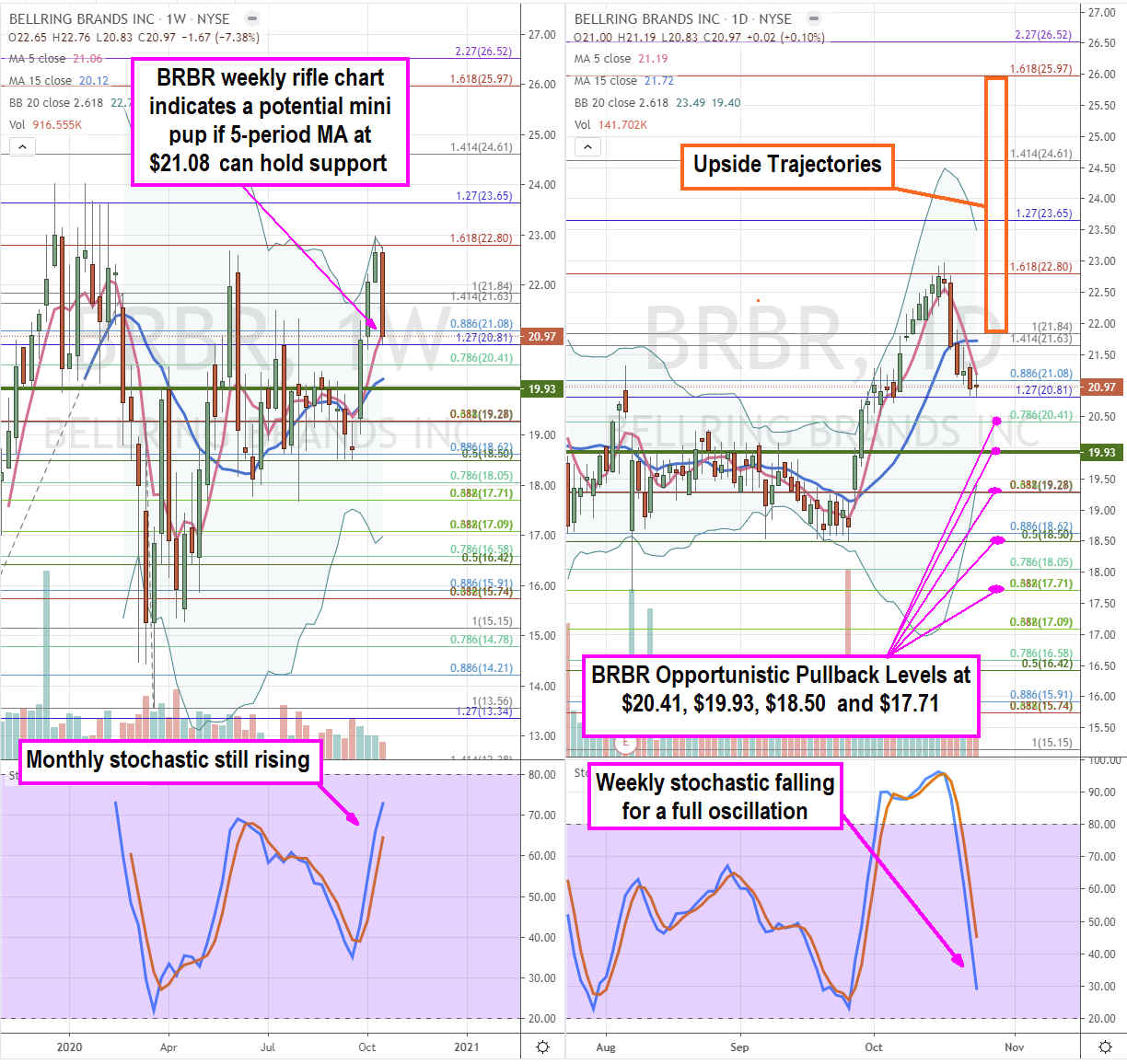
BRBR Opportunistic Pullback Levels
Using the rifle charts on the weekly and daily time frames provides a near-term view of the landscape for BRBR stock. The weekly rifle chart is testing its uptrend after triggering the market structure low (MSL) buy at $19.94 and peaking at the $22.80 Fibonacci (fib) level. Shares pulled back to test the weekly 5-period moving average (MA) at $21.08. The daily stochastic is completing a full oscillation down towards the 20-band. The question is whether the weekly 5-period MA can hold support long enough for the daily stochastic to bottom out and cross back up. In the meantime, prudent investors should prepare for opportunistic pullback levels at the $20.41 fib, $19.93 weekly MSL/fib, $18.50 fib, and the $17.71 fib. The upside trajectories range from the $21.84 to $25.97 fib levels. Patience is key as further selling can accelerate if the weekly 5-period MA support breaks on the daily stochastic oscillation down. It’s best to wait for the daily stochastic to bottom out and cross back up.
