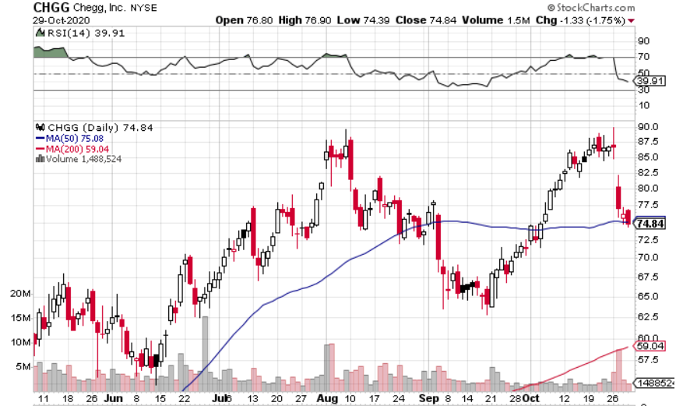
Chegg (NYSE: CHGG) reported its Q3 2020 earnings Monday after the bell, and while there was a lot of good news in the report, shares plummeted by 11% in Tuesday’s session. Chegg shares dipped further on Wednesday and Thursday; over the past three days, shares are down more than 13.5% total.
Let’s start by talking about why investors were disappointed by the Q3 report.
Guidance Wasn’t Good Enough
Chegg gave its initial outlook for 2021, and said that it is expecting revenue growth of 25% yoy for the full-year. Sounds great, eh? In a vacuum, yes, but for Chegg, it would be a significant slowdown from the 50% yoy growth seen in 2021.
The online learning leader became a victim of its own success. But is the disappointment justified? After all, Chegg is currently trading at 59.2x forward earnings and 15.2x forward sales.
Some level of disappointment was justified. The pandemic and resulting online learning shift are showing no signs of slowing down; it is understandable why the market was expecting higher growth.
On the other hand, Chegg will be facing tough comps from 2020. When you look at it that way, 25% growth doesn’t sound so bad. Furthermore, the 25% growth is similar to pre-pandemic levels; Chegg grew sales by 26% in 2018 and 28% in 2019. Chegg was a smaller company back then, so 25-30% growth was, in some respects, easier to achieve in those years.
Strong Q3 with Excellent Underlying Metrics
In Q3, revenue increased 64% yoy, a slight uptick from the 63% yoy growth experienced in Q2.
Chegg Services now has 3.7 million subscribers, up 67% yoy. This is an important metric, as Chegg Services is a high-margin business with each incremental subscriber contributing a lot to Chegg’s bottom line.
Another important metric is content views – those were up 82% yoy to 252 million in Q3. The fact that content views growth is outpacing subscriber growth shows that Chegg subscribers are getting a lot of value out of the service. Why does this matter? Because it’s likely to lead to higher retention rates and word-of-mouth referrals. It also matters for another reason…
Chegg Continues to Make Progress on Account Sharing
Two months ago, I talked about the steps that Chegg was taking to stop account sharing. I noted that Chegg is seen as an amazing value by many of its subscribers, which makes them more likely to buy their own subscriptions if prompted. Content views are just one more way to quantify Chegg’s value.
In Chegg’s Q3 release, CEO Dan Rosensweig talked about “the impact of our technology efforts to reduce account sharing, which was first rolled out in August and more recently, we began to launch multi-factor authentication across the platform as well.”
Growth Drivers are Still in Place
Back in June, I talked about five sources of upside for Chegg; subscriber growth, pricing power, tutoring and textbook services, sustainable adoption of learn-from-home technologies, and international expansion.
Shares are only trading around 10% higher now than they were then, which is very reasonable when you consider the trajectories of other pandemic winners over the past 4+ months.
So, by getting into Chegg now, you’re not paying much of a premium over June prices. But what you are getting is an increased certainty that learn-from-home is here to stay.
Chegg has posted impressive numbers over the past two quarters, and the pandemic is showing few signs of letting up as we move into the winter. The longer the pandemic lasts, the more learn-from-home gets integrated into the education system. That’s good news for Chegg shareholders.
Post-Earnings Dip Was Overdone
I’ve been singing Chegg’s praises for the better part of this article, but I do think that shares should be trading a little lower after the Q3 earnings release. I, like many others, was hoping for better guidance – perhaps growth projections in the 30%+ range.
That said, I think the sell-off has been overdone, making now a great time to get into Chegg.
Not to mention, there’s a silver lining with the lower guidance and subsequent dip: It will be easier for Chegg to beat lowered expectations in 2021. It all adds up to make Chegg a lower-risk, higher-reward play than it was last week. And it was an excellent play last week…
Companies in This Article:
