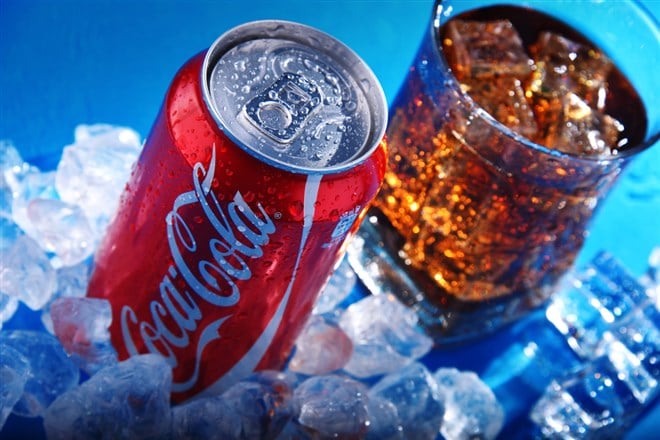
It was always a safe bet, for all the businesses the coronavirus has closed so far, that Coca-Cola (NYSE:KO) would not be among the closed businesses when all the dust settled. Sure, Coca-Cola lost many of its major channel partners, but people weren't going to walk away from a cold, sweet, and wholly familiar comfort drink during the worst of a pandemic. Now that even calling it a pandemic is a point for debate any more, we're starting to see Coca-Cola come back with its decline.
Not All the Numbers are Fantastic
Admittedly, Coca-Cola's earnings report is something of a mixed bag. Third-quarter revenue was actually down 9%, mostly because demand for several key products—like Dasani water, Powerade, and fountain drinks—were down on the various government responses to coronavirus.
However, despite a loss in revenue that should really surprise no one given how many places you can buy Coke products are still closed to this day, or otherwise running under capacity restrictions, the overall numbers turned out to be truly fantastic for the company. Overall revenue was still above expectations, as the company pulled in $8.65 billion against an expected $8.36 billion. Earnings per share came out ahead as well, with $0.46 per share expected, but $0.55 per share actually yielded.
Third-quarter net income, meanwhile, came in at $1.74 billion—which works out to $0.40 per share—a number that's sound objectively but flawed subjectively, as last year at this time the company pulled in $2.59 billion instead. There's actually better news; not only did the company's quarterly sales pull up from last quarter—and pretty handily, too—they're actually above several quarters that thought “coronavirus” was just a fancy word for “head cold”.
Responding to a Shifting Demand Picture
Naturally, product demand had some unexpected impact throughout this quarter. All four of its major categories saw some decline, though some much more so than others. The “sparkling soft drinks” sector saw the least impact, down just 1%, as the ongoing losses in the North American fountain business hit the company. But the demand for the Coke standards, along with Coke Zero Sugar, gave the category a good lift that let it overcome much of the worst of the demand slump.
There was a 6% loss, however, in “juice, dairy and plant-based drinks,” thanks to pressure in their primary market sectors of Latin America and the Asia-Pacific region. “Water, enhanced water, and sports drinks” lost 11%, and in the biggest hit—led mainly by the loss of the Costa cafe line—the company's “tea and coffee” lineup was hit to the tune of 15%.
Essentially, Coca-Cola found out what most figured would be the case all along. Sure, the loss of restaurants, movie theaters, amusement parks and the like was a big hit to the company, but since the stuff can be bought in cans and bottles and taken home anyway, home sales made up for most of the losses.
Already the company is responding to the changed circumstances; several brands are being cut from the roster, and Coca-Cola is narrowing its focus. The company already plans to cut its master brand lineup to around 200, down from its original total of about 400. Drinks like Tab, which haven't sold well in a long time, are already out.
Coca-Cola is Still Worth a Buy
The company made some major gains in pre-market trading today, and though it gave back some of those gains, it still demonstrated why it's considered a buy. Our latest research shows that the company has a consensus rating of buy, and one that's actually on the rise.
Just 30 days ago, the company held four “hold” ratings, 15 “buy” ratings and one “strong buy.” The “strong buy” is still in place, but now the company has 13 “buy” ratings and three “hold”, which improves the percentage of “buy” recommendations. The price target has slid a bit, but over the last 180 days, it's come down just over a dollar to $53.65. It also doesn't hurt that no one's changed their rating on the company since Morgan Stanley upgraded to “overweight” back in July.
Coca-Cola has made a lot of changes over the last few months, and those changes have for the most part been taken well. Sure, the “TaBaholics” out there are going to be crushed to lose Tab—I personally mourn the loss of Vanilla Coke—but the company is still going strong despite many of its sales vectors being lost to government reaction to the coronavirus. At the end of the day, though, many will still find a Coke a welcome treat, and that will keep Coca-Cola a valuable part of most any portfolio.
Companies in This Article:
