Video game retailer
GameStop (NYSE: GME) stock has rallied sharply in recent weeks due to the pre-launch of next-generation consoles
Sony PlayStation 5 (NYSE: SNE) and the upcoming
Microsoft Xbox Series X console
(NASDAQ: MSFT) . While shares have finally surpassed it pre-pandemic price range catching up to the performance of the benchmark
S&P 500 index (NYSEARCA: SPY) , continued upside is questionable after the consoles are released. GameStop primarily benefits from physical hardware and software purchases. Its antiquated business model falls flat when its own suppliers are pushing customers towards digital purchases and memberships that bypasses GameStop all together. Investors have been given an opportunity to unwind positions into the hype of next-gen console releases squeezing up the stock into opportunistic exit levels.
Q2 FY 2020 Earnings Release
On Sept. 9, 2020, GameStop released its second-quarter fiscal 2020 results for the quarter ending July 2020. The Company reported an earnings-per-share (EPS) loss of (-$1.40) excluding non-recurring items versus consensus analyst estimates for a loss of (-$1.14), missing estimates by (-$0.26). Revenues fell (-26.7% year-over-year (YoY) to $942 million versus $1.02 billion consensus analyst estimates. Comparable store sales fell (-12.7%) due to COVID-19 closures and fewer store operating days. Gross margins fell (-420 bps) driven by higher hardware sales which carry lower gross margins. Software sales were down (-31%) YoY.
The silver lining was the 800% YoY growth in e-commerce sales which accounted for 20% of Company revenues, up from low single digits. The Company plans to enhance e-commerce sales with the rollout of a newly redesigned mobile app. GameStop was able to lower inventory levels by 50% and cut accounts payable by 30% to generate $182 million in free cash flow for the quarter. The Company also reduced credit facility borrowings by (-$100 million) to end the quarter with $735 million in cash.
Next-Gen Consoles
The Sony PlayStation 5 is slated to officially release on Nov. 17, 2020, but pre-orders already sold-out in minutes. It was a fiasco to say the least as speculators stuffed the queues to get pre-orders and immediately sell on eBay (NASDAQ: EBAY) for double and triple the retail price tag. There’s a misconception that GameStop will be receiving a wave of new customers and products with the next-gen consoles. The migration to digital directly from hardware and video game developers leaves them out of the loop with the exception of one-time sales. On the second quarter conference call, CEO George Sherman stated that next-gen consoles still have operating disk drives and foresees the relevance of physical games for the next seven years. The increased “taxation” on broadband with work at home activities force gamers to make “trade-offs”. He stated, “We are not debating the growth of digital gaming however, we are simply saying that the life of physical gaming is here to stay for the foreseeable future.” Famous last words? This is reminiscent of another former industry giant that fell behind the technology curve.
The Blockbuster Video of Gaming
GameStop faces tremendous competition with game distributors Amazon (NASDAQ: AMZN) . Retail behemoths Target (NYSE: TGT) , Best Buy (NYSE: BBY) and Walmart (NYSE: WMT) have dedicated store aisles stocked with physical video games and accessories. GameStop has a niche with the used game market but when these can be downloaded cheaper online, there’s virtually no incentive to buy them in store. This is especially true when the special bonus codes have already been used by prior owners. With the exception of legacy games, the Company’s business model is outdated on borrowed time sharing the same fate as Blockbuster Video. But unlike a rising competitor like Netflix (NASDAQ: NFLX) , it’s the very one video publishers like Electronic Arts (NASDAQ: EA) , Activision (NASDAQ: ATVI) and Take-Two Interactive (NASDAQ: TTWO) that are perpetuating and accelerating the migration digital downloads, services and purchases. Unfortunately, the trend is been migration to digital downloads and recurring billing “game passes” where gamers subscribe to regular updates as well as in game microtransactions. All of which bypass GameStop’s reach. The hype for next-gen consoles is white hot right now ahead of official launches. This presents investors an opportunity to unwind positions into liquidity before the initial surge of console purchases fades and reality sets back in again.
GME Opportunistic Exit Levels
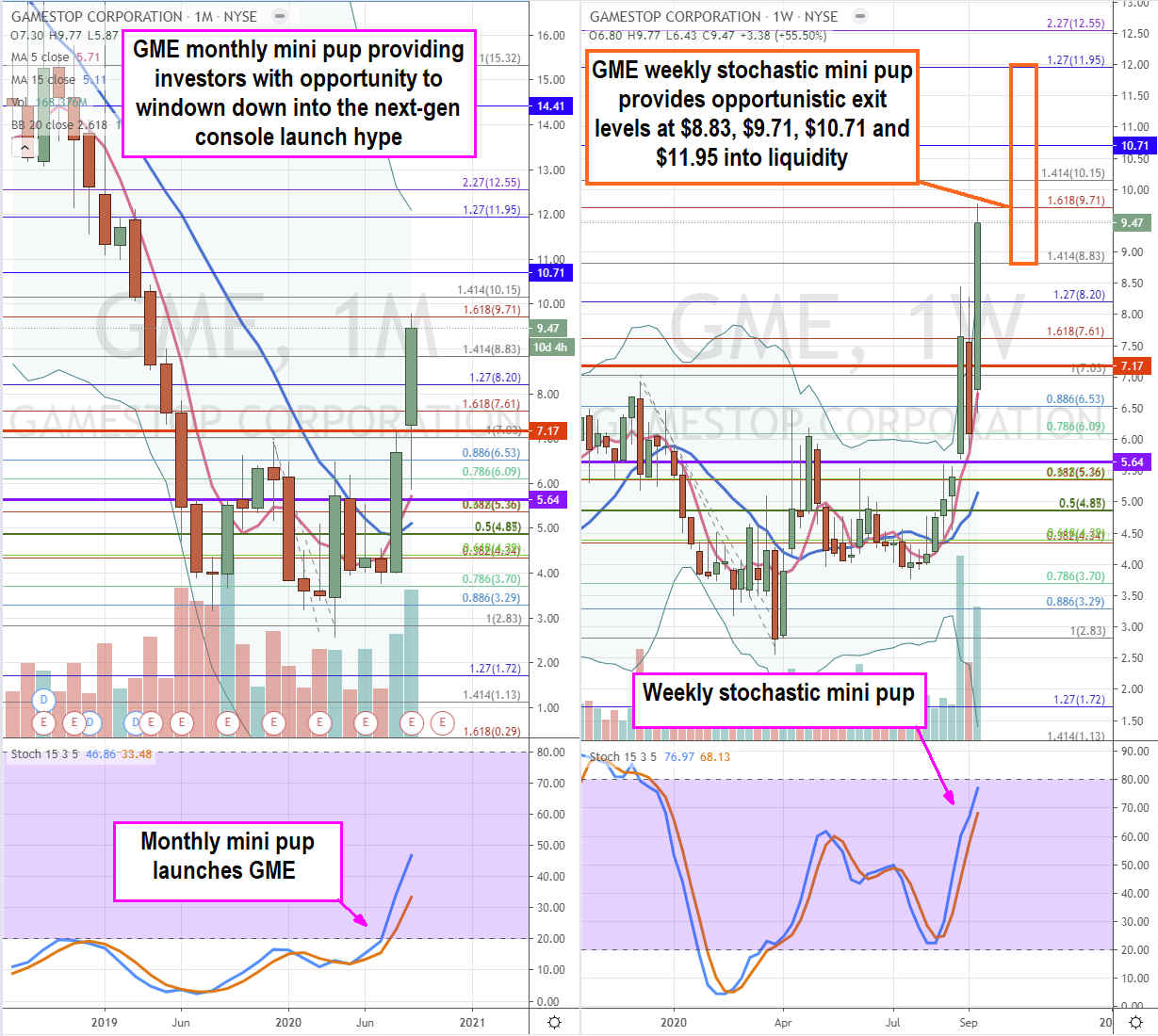
Using the rifle charts on the monthly and weekly time frames provides a broader view of the landscape for GME stock. The monthly rifle chart has a stochastic mini pup which triggered a market structure low (MSL) buy above $5.64. The monthly 5-period moving average (MA) support overlaps with the MSL trigger. The monthly upper Bollinger Bands (BBs) have an upside trajectory towards the $11.95 Fibonacci (fib) level. The weekly stochastic formed a stochastic mini pup boosting it through its upper BBs at $8.47. The dual monthly and weekly mini pup are fueling this powerful spike which is providing opportunistic exit levels at the $8.83 fib, $9.71 fib, $10.71 fib and $11.95 monthly upper BBs and overlapping fib. With potential upside to the monthly upper BBs, investors should monitor the momentum to consider winding down positions on the way up into liquidity, rather than on the way down when the hype dries up.
Companies in This Article:
