
Iconic beauty and cosmetics company
Revlon, Inc. (NYSE: REV) stock has been in a meltdown as it approached potential bankruptcy after missing a Nov. 16 deadline on $1 billion senior loan payments. However, the Company reached a deal with some of its bond holders to accept lower debt payments to avoid bankruptcy. This caused shares to skyrocket to $14.56 from lows of $3.96 the prior week. Shares were trading around $26 a year ago when buyout rumors transpired before the
pandemic. While shares are still underperforming the benchmark
S&P 500 index (NYSEARCA: SPY), it may be a potential turnaround play for high risk-tolerant investors as shares recede to opportunistic pullback levels.
Q3 FY 2020 Earnings Release
On Nov. 12, 2020, Revlon released its fiscal third-quarter 2020 results for the quarter ending September 2020. The Company reported an adjusted earnings-per-share (EPS) loss of (-$0.58) excluding non-recurring items versus consensus analyst estimates for a loss of (-$0.61), beating estimates by $0.03. Revenues fell by (-20%) year-over-year (YOY) to $477.1 million missing analyst estimates for $566.7 million. As of Sept. 18, 2020, the Company had $344 million of liquidity composed of $271 million cash, $53 million in remaining revolver with up to $1 billion in notes due in November 2020.
Q2 2020 Conference Call Takeaways
In the prior Q2 earnings call, Revlon CEO, Debra Perelman stated that all of the declines were attributed to the effects of COVID-19. She reiterated, “It is worth noting that excluding the impact of both COVID-19 and FX, our second quarter 2020 net sales would have remained essentially flat relative to the prior year period.” The most recent third-quarter shows sequential improvement with the acceleration of restarts across the nation as stay-at-home mandates were lifted.
The Brands
Revlon is a global cosmetics company with a portfolio of highly recognized brands including Elizabeth Arden, Mitchum, Almay, American Crew, Crème of Nature, Cutex, Juicy Couture, Elizabeth Taylor, Britney Spears, Curve, John Varvatos, Christina Aquilera and AllSaints. Granted some of these brands are antique in nature compared to current trends, they still carry intrinsic value. The Company has gone from a takeover prospect to a bankruptcy risk in less than a year as the COVID-19 pandemic accelerated losses causing debt servicing risks and breach of debt covenants. The largest shareholder is legendary 1980s era financier billionaire Ron Perelman, with and 87% stake in the Company.
Revlon Debt Restructuring Progress
On Nov. 11, 2020, Revlon announced a preliminary note exchange offer noting that $236.5 million aggregate principal of the 5.75% Senior Notes due 2021 had been tendered. These were tendered the Company’s previously announced exchange offer. Revlon Chairman Ron Perelman struck a deal with Carl Icahn, a major bondholder to accept lower debt repayments. This news sent shares skyrocketing to a high of $14.56 before receding. While total outstanding shares sit at 53.3 million shares, Ron Perelman isn’t likely trading his 87% stake. The explosive price spike can be attributed to a short-squeeze due to the razor-thin float of just 6.83 million shares with nearly half the float short as of Oct. 29, 2020. The Company has $5.03 cash per share (CPS). Since there is a risk of insolvency versus a turnaround or acquisition, only high risk-tolerant investors and nimble traders should even consider looking for opportunistic pullback levels to consider any exposure.
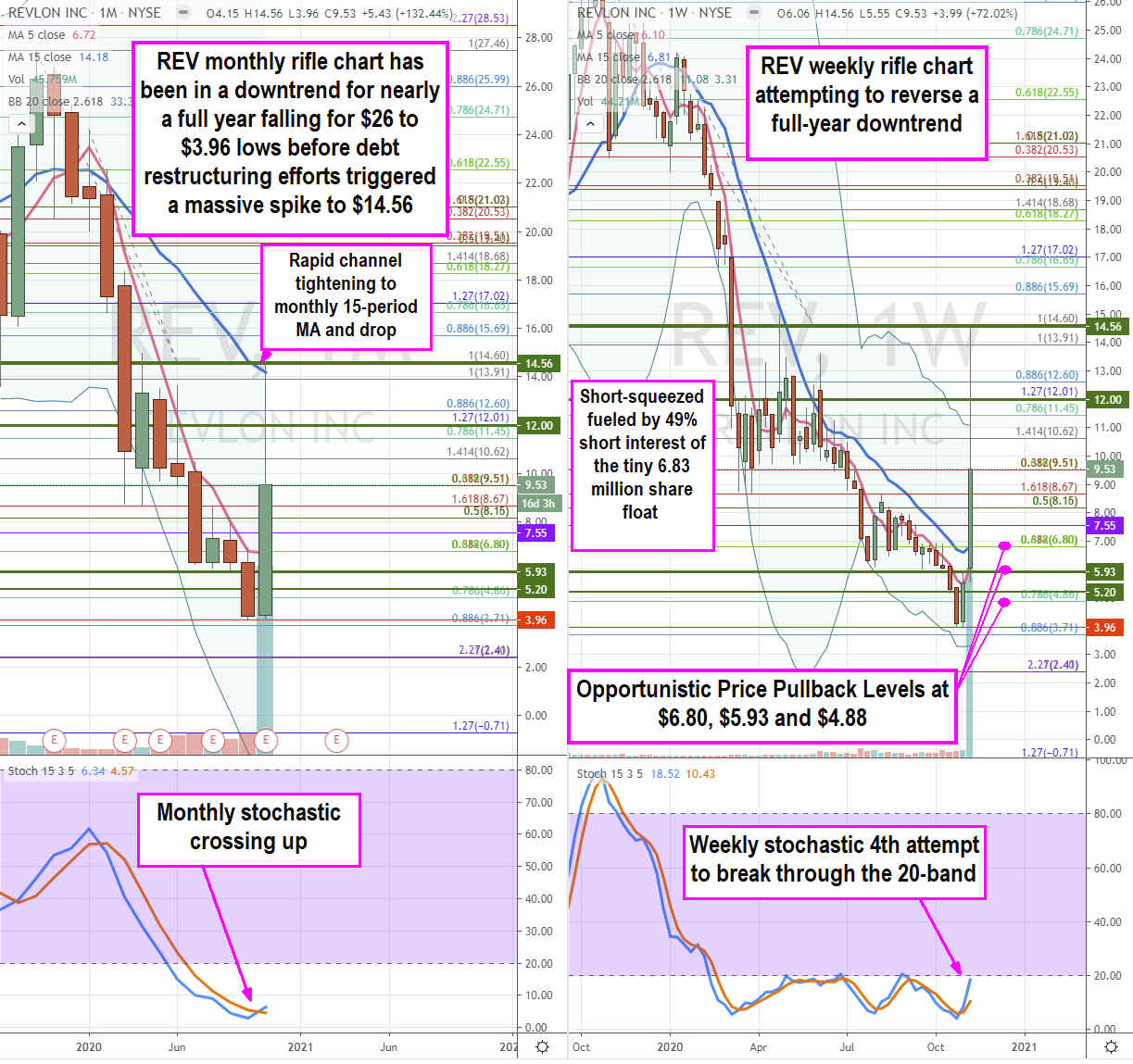
REV Opportunistic Pullback Levels
Using the rifle charts on the monthly and weekly time frames provides a broader view of the landscape for REV stock. The monthly rifle chart has been in a bearish breakdown for over a year as it full below all market structure low (MSL)levels. There are two near-term MSLs composed of the daily MSL trigger above $5.20 and the weekly MSL trigger above $5.93. The monthly MSL triggers above the recent high of $14.60 Fibonacci (fib) level. The volatile price action is attributed to the tiny float and nearly 50% short interest. Nimble traders can trade the reversions off opportunistic pullback levels at the $6.80 daily 15-period moving average (MA)/fib, $5.93 weekly MSL/fib and the $4.88 fib. Risk-tolerant investors can limit their downside by implementing options strategies as REV has options. Due to the thin float, the options may also have slippage and liquidity issues, so patience is key.
Companies in This Article:
