
There’s no one quite like Howard Stern;
Sirius (NASDAQ: SIRI) and the company’s investors are both keenly aware of that.
So, when the news came out last week that the radio star is in talks to renew his contract, investors rejoiced, sending shares up nearly 5% on the news.
Stern’s contract is set to expire at the end of this year, and reports are pegging the new deal at $120 million a year. Stern’s previous contracts were nearly as lucrative, topping out at $80-$100 million.
It’s a lot of money, but there’s a reason why shares jumped on the news: he’s worth it.
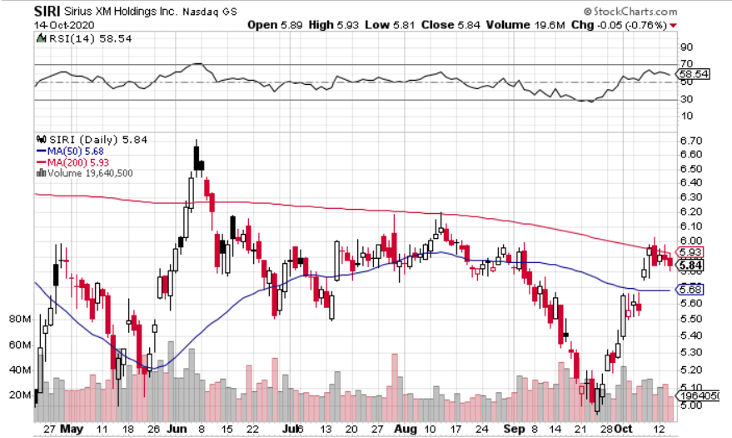
Credit Suisse analyst Brian Russo, for one, believes that if Stern left, around 2.7 million people would cancel their Sirius subscriptions. He raised his price target to $7.50 from $6.25 on the news, well above the current share price.
This is great news, and the market reaction was certainly justified. But Stern is 66 years-old; whether he retires or does eventually take his show elsewhere, he won’t be with Sirius forever.
Fortunately for Sirius investors, the company looks well-positioned for short-term and long-term success.
Sirius Can Afford to Be Patient with Pandora
Back in February of 2019, Sirius closed a $3.5 billion all-stock deal for Pandora.
Pandora has had its ups-and-downs, and recently more of the downs; monthly active users have gone from 64.9 million to 59.6 million over the past year.
Advertising dollars have been tough to come by since the onset of the pandemic, and Pandora has been no exception. It’s important to note, however, that Pandora is trending in the right direction on this front. On the Q2 earnings call, CEO Jim Meyer noted, “We've also been pleased that the reduction of advertising-supported listening hours at Pandora has been abating. After being down as much as 18% early in the second quarter, ad hours finished the quarter down less than 6% compared to the prior period.”
The competition is fierce in the audio streaming world, with 20-30% yoy growth the norm at Spotify (NYSE: SPOT).
But it’s important to note two things:
- Spotify has a market cap of nearly $50 billion, more than 13x what Sirius paid for Pandora.
- Sirius generates a lot of free cash flow – this year’s projection is $1.6 billion – and can afford to be patient with Pandora.
Even if Pandora doesn’t pan out, Sirius has made another major acquisition that has potential.
Sirius Bought Stitcher in July
Three months ago, Sirius agreed to buy Stitcher from E.W. Scripps (NYSE: SSP) for $325 million.
Stitcher brings a lot to the table including original podcasts, advertising, and distribution.
The combined audience of Stitcher, Sirius XM satellite radio, and Pandora will be a staggering 150 million listeners.
People Are Getting Back on the Roads
One of the biggest headwinds in Q2, which ended on June 30, was that fewer people were on the roads; millions of people listen to satellite radio in their cars.
SIRI has several deals with automakers to get built-in Sirius XM radios put into their cars. Automakers were forced to shut down for a couple of months earlier this year, which put a dent in SIRI’s business.
But the good news is that automakers are starting to ramp-up production, which should give SIRI a boost.
In fact, there are two more reasons to be bullish about people getting back on the roads – and listening to Sirius XM satellite radio:
- According to urgently, traffic returned to pre-pandemic levels the week of June 7.
- The used car market has been hotter than expected.
On that second point, CEO Jim Meyer had this to say on the Q2 earnings call:
“Used car penetration is now a shade under 50%, up about 500 basis points versus this time last year. While new vehicle starts fell 26% in the second quarter, used vehicle starts fell only 5%. And for the first time ever, we had more used car trials than new car trials.”
The Verdict
Spotify is getting a lot of press, and justifiably so.
Though Sirius isn’t as glamorous, the valuation is much more reasonable than Spotify’s, and SIRI’s massive audience gives it a lot of potential. Consider picking up some SIRI shares.
Companies in This Article:
